

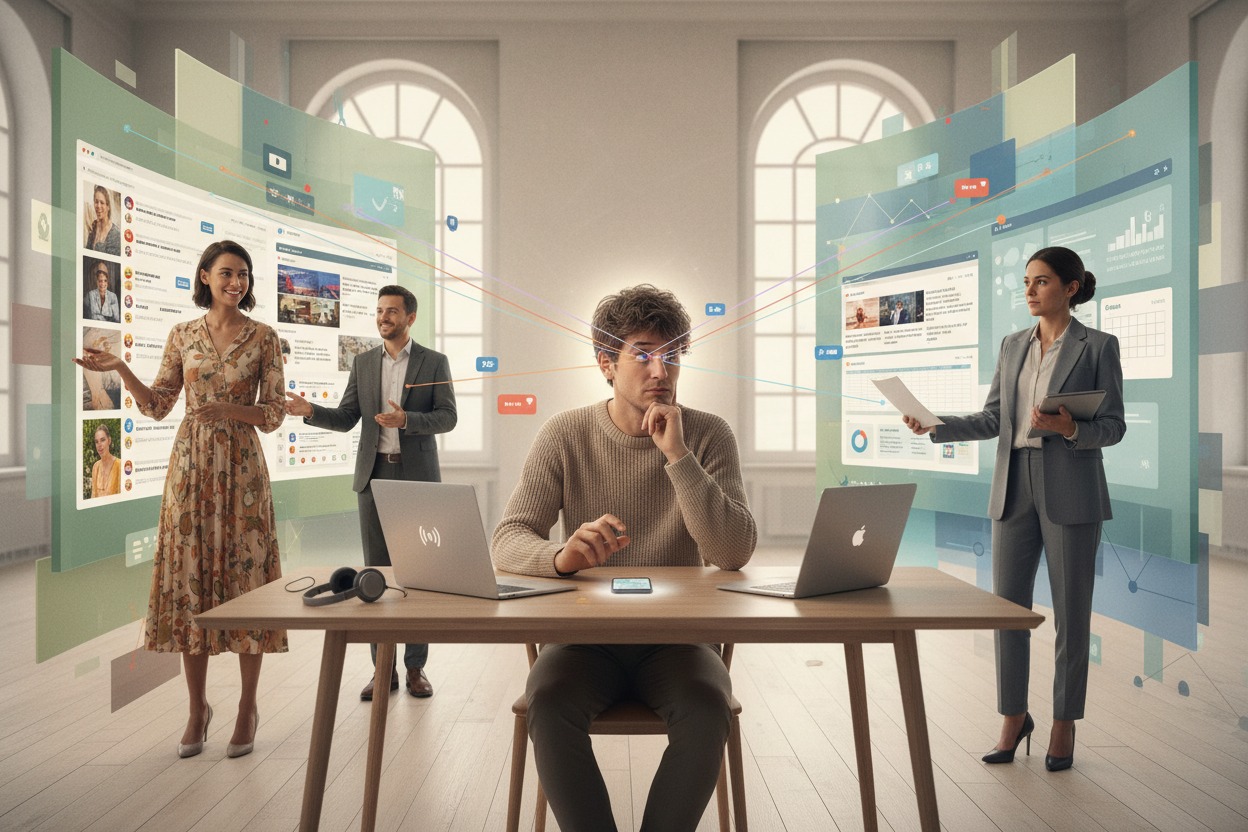
Have you ever opened social media for a few minutes and found yourself still scrolling much later?
It is easy to think this means we simply need more self-control. But there is another way to look at it.
Social media platforms are designed to compete for our attention. Recommendation systems use signals from our interactions to predict what we’re likely to engage with — including actions such as clicks, likes, shares, replies, video viewing and time spent with content.[1]
Our behavior becomes the input. Engagement becomes the output.
The platform benefits when it can keep our attention. We get an endless stream of content selected to make the next scroll feel worth taking.
And this is where awareness matters.
Imagine someone puts a large bowl of your favorite sweets next to your desk. You see them every time you look up. You can eat them, of course—but if you eventually eat a few, would it really make sense to blame yourself for having poor discipline?
Social media can work in a similar way.
There is nothing inherently wrong with enjoying it. The problem is that we often place ourselves inside an environment specifically designed to invite repeated attention, and then blame ourselves for responding to it.
Perhaps the better approach is not stronger willpower, but better surroundings.
Turn off unnecessary notifications. Keep social apps away from your home screen. Decide when you want to check them instead of checking whenever they call for you. Create spaces in your day where nothing is competing for your attention.
You don’t need to fight the algorithm.
You can simply give it less access to you.
Sources & Further Reading
[1] Dragan, A. et al. (2025). Engagement, user satisfaction, and the amplification of divisive content on social media. PNAS Nexus.